
Not all hair loss is the same. The type you're experiencing determines whether it's permanent or likely to resolve, what's driving it, and what your options actually are. The most common mistake people make when researching hair loss is applying information about one type to a completely different condition.
Androgenetic alopecia, called male pattern baldness in men and female pattern hair loss in women, accounts for the vast majority of cases. In men, it's driven by genetic sensitivity to dihydrotestosterone (DHT), causing follicles to miniaturize progressively over time. The pattern is characteristic: hairline recession at the temples forming an M-shape, combined with crown thinning, gradually merging in more advanced stages. It's permanent and progressive, though the rate varies considerably between individuals.
In women, it typically presents as diffuse thinning across the top of the scalp rather than a defined recession pattern, which can make it harder to recognise. The underlying mechanism is similar, but the hormonal interaction is more complex. Both men and women can experience it at any age, though it becomes more common with age.
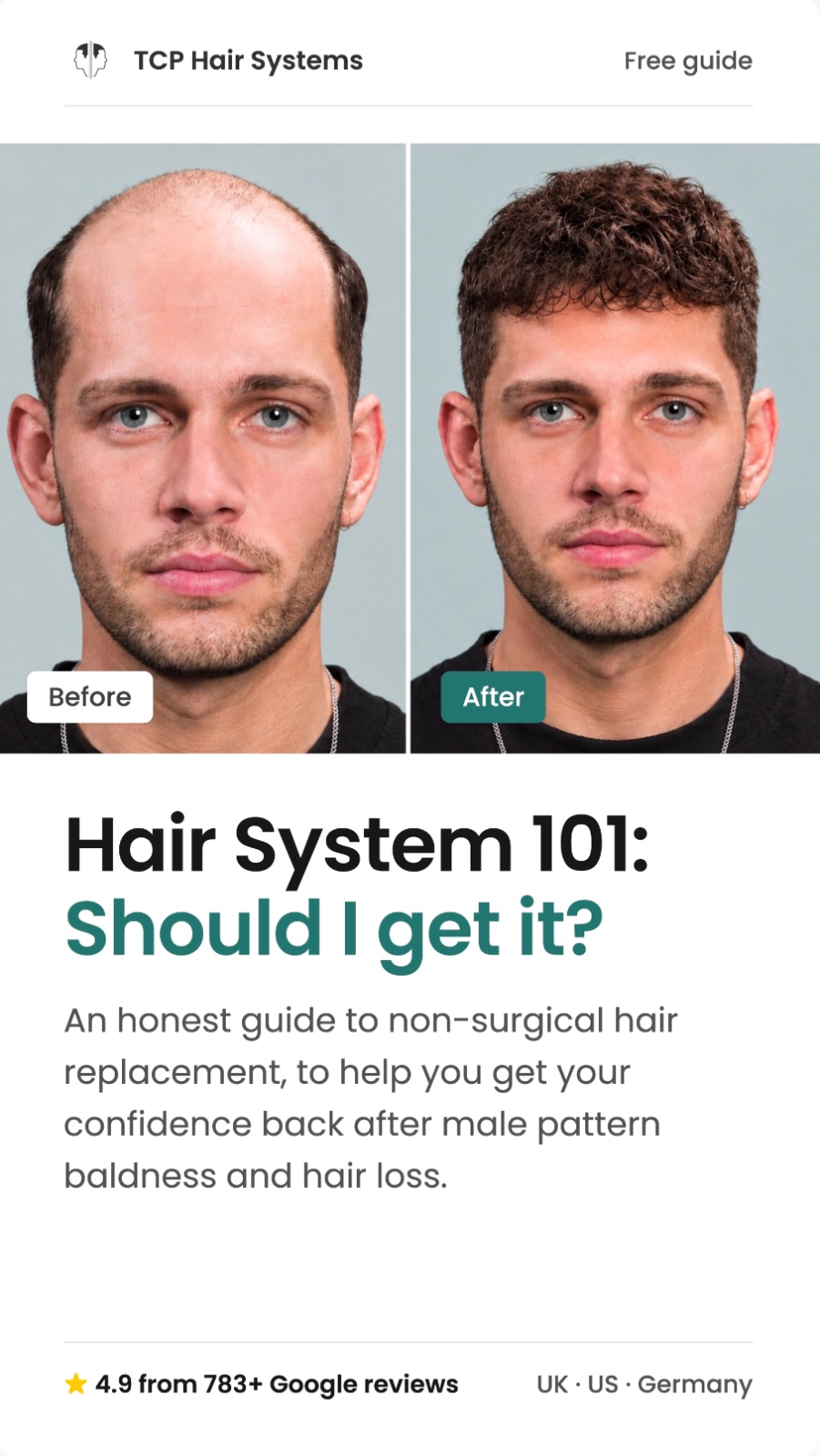
There's no cure. Medications like minoxidil and finasteride can slow the process but don't restore lost hair. A non-surgical hair system from TCP replaces the hair directly and works at any stage. We cover the full landscape of options in our article on what causes hair loss and whether there's a cure for male pattern baldness.
Alopecia areata is an autoimmune condition where the immune system mistakenly attacks hair follicles, causing them to stop producing hair. Its lifetime risk is about 2% globally, and it can occur at any age, including in children. Unlike androgenetic alopecia, the follicles remain alive and intact, so regrowth is biologically possible, though the condition is unpredictable and regrowth isn't guaranteed.
It typically presents as one or more smooth, round patches of complete hair loss on the scalp, often appearing suddenly over days to weeks. Patches can vary from coin-sized to much larger and appear anywhere on the scalp or body. Some regrow spontaneously within months, though the condition can recur; others continue spreading. The more extensive forms are alopecia totalis (complete scalp hair loss) and alopecia universalis (complete body hair loss, including eyebrows and eyelashes).
The exact trigger isn't fully understood. Genetics play a role, family history raises risk. Significant stress or illness can sometimes trigger an episode or cause existing patches to spread, though stress alone isn't a direct cause. There's an association with other autoimmune conditions, including thyroid disease and vitiligo.
Treatment options include corticosteroid injections directly into affected areas, topical immunotherapy, and, for more severe cases, JAK inhibitor medications. According to the National Alopecia Areata Foundation, three JAK inhibitors are FDA-approved specifically for severe alopecia areata: baricitinib, ritlecitinib, and deuruxolitinib. None of these are cures, and results vary. For people with significant or extensive alopecia areata who want a complete result while managing the condition, a TCP hair system works regardless of the extent of loss.
The second most common cause, and one of the most frequently misidentified. A significant physical or psychological stressor disrupts the normal hair growth cycle, pushing a large proportion of follicles simultaneously into the resting phase. These follicles shed roughly 1 to 6 months after the triggering event, which is why people often don't connect the shedding with what caused it.
Common triggers: major illness, surgery, significant weight loss, childbirth, bereavement, or sustained high stress. Shedding is typically diffuse across the whole scalp rather than patterned, distinguishing it from androgenetic alopecia. Increased hair on pillowcases, in the shower drain, and on brushes is usually the first thing people notice. It typically peaks a few months after the trigger, then gradually normalizes as the hair cycle restabilizes.
Telogen effluvium is generally temporary, and hair usually regrows fully once the trigger resolves. Chronic telogen effluvium, persisting beyond six months without clear resolution, does occur and warrants a GP visit to rule out thyroid dysfunction or iron deficiency.
Traction alopecia comes from repeated mechanical tension on follicles, most commonly from tight hairstyles: braids, ponytails, weaves, and extensions worn over extended periods. It typically begins at the hairline and temples, where tension is highest. According to the British Association of Dermatologists, regrowth can start around 3 months after stopping the tight styling and letting the hair cycle recover, but if the tension continues long enough, the damage can become permanent. It's significantly more common in women, particularly those who regularly wear tight protective styles.
Hormonal hair loss covers postpartum hair loss (a form of telogen effluvium triggered by the hormonal shift after childbirth, typically resolving within a year), and hair loss linked to menopause, PCOS, and thyroid disorders. Both underactive and overactive thyroid disrupt the hair cycle and cause diffuse shedding, this typically improves once the imbalance is treated, though the timeline varies. If hair loss comes with fatigue, weight changes, or irregular periods, a blood test is a useful first step.
Cancer-related hair loss is primarily linked to chemotherapy, which targets rapidly dividing cells throughout the body, including hair follicles, causing significant, often sudden hair loss. It's typically temporary, with regrowth beginning some months after treatment ends, though texture and colour can differ from the original hair. For people going through treatment who want to maintain their appearance, a TCP hair system is something we're experienced in supporting.
The most reliable feature is pattern. Androgenetic alopecia follows the Norwood pattern in men (hairline recession plus crown thinning) or diffuse thinning in women. Alopecia areata presents as distinct smooth patches. Telogen effluvium and hormonal causes tend to produce generalised diffuse shedding without a specific pattern. Traction alopecia concentrates at the hairline and areas of greatest tension.
Timing helps too. Androgenetic alopecia develops gradually over months and years. Telogen effluvium typically follows a stressful trigger by some months, then peaks before resolving. Alopecia areata can appear suddenly, patches developing over days to weeks.
If you're uncertain, a GP is the right first step. A blood test can rule out thyroid conditions, iron deficiency, and hormonal causes relatively quickly. If those come back clear and the pattern fits androgenetic alopecia, that changes the conversation to long-term management. Our article on the signs and stages of male pattern baldness can help you assess whether the pattern fits.
For androgenetic alopecia and alopecia areata, a TCP hair system gives you an immediate, complete result while you work through whatever else you're managing. It's not a treatment for the underlying condition, but it means your appearance doesn't have to wait for an uncertain medical outcome.
Your first consultation is completely free and confidential, no pressure, no commitment. We have studios across the UK, US, and Germany. Book your free consultation today, or see our pricing to find a plan that works. See what our results look like in our before-and-after gallery.
Every system is also backed by our money-back guarantee. If you're not happy with the result, we make it right, no small print, no exceptions for first-time clients.
Also Read: What Causes Hair Loss in Men? | What Are the Signs and Stages of Male Pattern Baldness? | Is There a Cure for Male Pattern Baldness?


We believe so much in our product that we provide a 100% money back guarantee should you not be satisfied with it.
Everything we tell you on our website is real. But we don’t just want you to simply take our word. We know that getting a hair system can seem like a big commitment at first, so we want to make the process as safe and easy as possible. If you, for whatever reason, are not fully satisfied with the standard hair system we will give you your money back.
Here’s how it works:
If you are a first time customer we will refund the full cost of the 1st Standard hair system if you return your standard TCP hair system to the hair studio within 5 business days after the initial application. This applies whether you're on Pay As You Go or Membership, and covers both Standard and Bespoke systems. At the hair studio you will be asked to fill out our return form. Once you have done this, the salon will refund your money in full for the cost of the 1st standard TCP hair system.
What’s not to like?
No.
We know that our TCP AirActive Skin® hair system is the best product on the market and freedom is an essential part of our philosophy.
That’s why we have a solution for everybody – it is up to you if you stay independent with our PAY AS YOU GO option or if you opt for the TCP Membership with its discounted hair system prices. There are no maintenance obligations. The Total Cover Plus hair system should adapt to your life and not vice versa.
Yes. The Total Cover Plus hair system is only removed during your next appointment at the salon, just before you get your new hair system. You can shower in it, exercise in it, do everything as you normally would.
Unlike most other hair replacement methods, which are painful and/or have serious side effects, the Total Cover Plus hair system does NOT hurt at all. We use medical grade, pH neutral materials that have never caused any allergic reactions and do not pose any risk to your health.