Hair loss affects around 6.5 million people in the UK. But not all hair loss is the same, and that distinction matters more than most people realise. The cause of your hair loss determines whether it's permanent or likely to resolve on its own, what options are available, and what result you can realistically expect.
Androgenetic alopecia, commonly called male pattern baldness, is responsible for the vast majority of hair loss in men, accounting for most of that 6.5 million figure. It's driven by genetic predisposition combined with sensitivity to dihydrotestosterone (DHT), a hormone derived from testosterone. In genetically susceptible people, DHT causes hair follicles to miniaturize progressively, producing increasingly fine hair before eventually stopping altogether. This is a permanent, progressive process.
The characteristic pattern: a receding hairline at the temples forming an M-shape, combined with crown thinning. These areas gradually expand and eventually merge in more advanced stages, following the Norwood-Hamilton scale from Type 1 (no loss) to Type 7 (extensive loss). Progression speed varies significantly, some people move through several stages in a few years, others stay stable for a decade or more.
The genetics are polygenic, involving multiple genes rather than one inherited trait. Both maternal and paternal family history matter, having significant hair loss on both sides is a stronger predictor than either side alone. There's no cure, but there are real options for managing it. Our dedicated articles on what age male pattern baldness starts and the signs and stages cover the full science and progression in detail.
The critical difference between androgenetic alopecia and most other causes is permanence. When hair loss has a temporary trigger, the follicles themselves are typically still healthy, once the trigger resolves, the hair usually returns. That doesn't make it less distressing while it's happening, but the approach is different. Knowing which category you're in is the most useful first step.
Telogen effluvium (stress and shock-related shedding). The second most common cause, and the one most often mistaken for the start of permanent hair loss. According to NIH research, a significant physical or psychological stressor pushes a large proportion of follicles simultaneously into the resting (telogen) phase, causing widespread shedding roughly 1 to 6 months after the triggering event, common triggers include major illness, surgery, significant weight loss, bereavement, or extended intense stress. Hair growth typically starts restarting within about 6 months once the trigger has passed, though it takes longer for the improvement to become visually obvious. Because of the delay, people often don't connect the two. The key distinguishing feature: shedding is diffuse across the whole scalp rather than patterned.
Nutritional deficiencies. Iron deficiency is the most well documented, particularly in women, but it affects men too, worth checking with a GP if hair loss comes with fatigue or pallor. Vitamin D, zinc, and inadequate protein intake are also associated with thinning and shedding. Biotin deficiency can cause hair loss too, though a genuine deficiency is rare with a varied diet. Nutritional causes are generally reversible once corrected, though it can take several months to see meaningful improvement. Supplements alone don't reverse established androgenetic alopecia.
Medical conditions. Alopecia areata is an autoimmune condition where the immune system attacks hair follicles, causing patchy loss on the scalp or elsewhere. Its lifetime risk is about 2% globally. It can range from small patches to complete scalp loss (alopecia totalis) or whole-body loss (alopecia universalis). Unlike androgenetic alopecia, the follicles remain intact, so regrowth is possible. Thyroid conditions, both hypothyroidism and hyperthyroidism, disrupt the hair growth cycle and can cause diffuse shedding, this typically improves once the underlying condition is treated. Lupus and other autoimmune conditions can also cause hair loss through the same immune-mediated mechanism.
Medication-induced hair loss. Often overlooked as a cause. Chemotherapy drugs are the most significant, affecting all rapidly dividing cells including follicles. Beyond that, certain blood thinners, antidepressants, blood pressure medications, and some hormonal treatments have been associated with shedding. It's typically diffuse rather than patterned and usually resolves after the medication is changed, though only in consultation with the prescribing doctor. If you've started something new and noticed increased shedding, mention it to your GP.
The most reliable distinguishing feature is the pattern of loss. Androgenetic alopecia follows the specific Norwood pattern, hairline recession at the temples forming an M-shape, combined with crown thinning, gradually expanding over time. If your hair loss follows this pattern, androgenetic alopecia is almost certainly involved. Temporary causes like telogen effluvium and nutritional deficiency tend to cause diffuse, generalised shedding across the whole scalp instead. Alopecia areata typically presents as distinct patches rather than gradual thinning.
Timing is another useful indicator. Androgenetic alopecia develops gradually over months and years. Telogen effluvium causes a noticeable spike in shedding some months after a stressful event, if you can identify a specific trigger in the preceding months, that's a meaningful clue. Medication-induced hair loss usually begins within three months of starting something new.
If you're uncertain, a GP is the right first step. A blood test can rule out thyroid conditions, iron deficiency, and other medical causes relatively quickly. If those come back clear and the pattern fits androgenetic alopecia, that changes the conversation to long-term management rather than investigation. Our article on the signs and stages of male pattern baldness can help you assess whether the pattern fits.
For temporary causes, the priority is identifying and addressing the trigger. Telogen effluvium resolves on its own once the stressor has passed. Nutritional deficiencies respond to dietary changes and appropriate supplementation under medical guidance. Medical conditions causing hair loss are managed by treating the underlying condition. In these cases, aggressive intervention usually isn't necessary.
For androgenetic alopecia, the picture is different. There's no cure, and it's progressive. Medications like minoxidil and finasteride can slow the process but don't restore what's already lost. Hair transplant surgery is an option for some but carries real cost, recovery time, and eligibility limits. Our article on whether there's a cure for male pattern baldness covers all these options honestly.
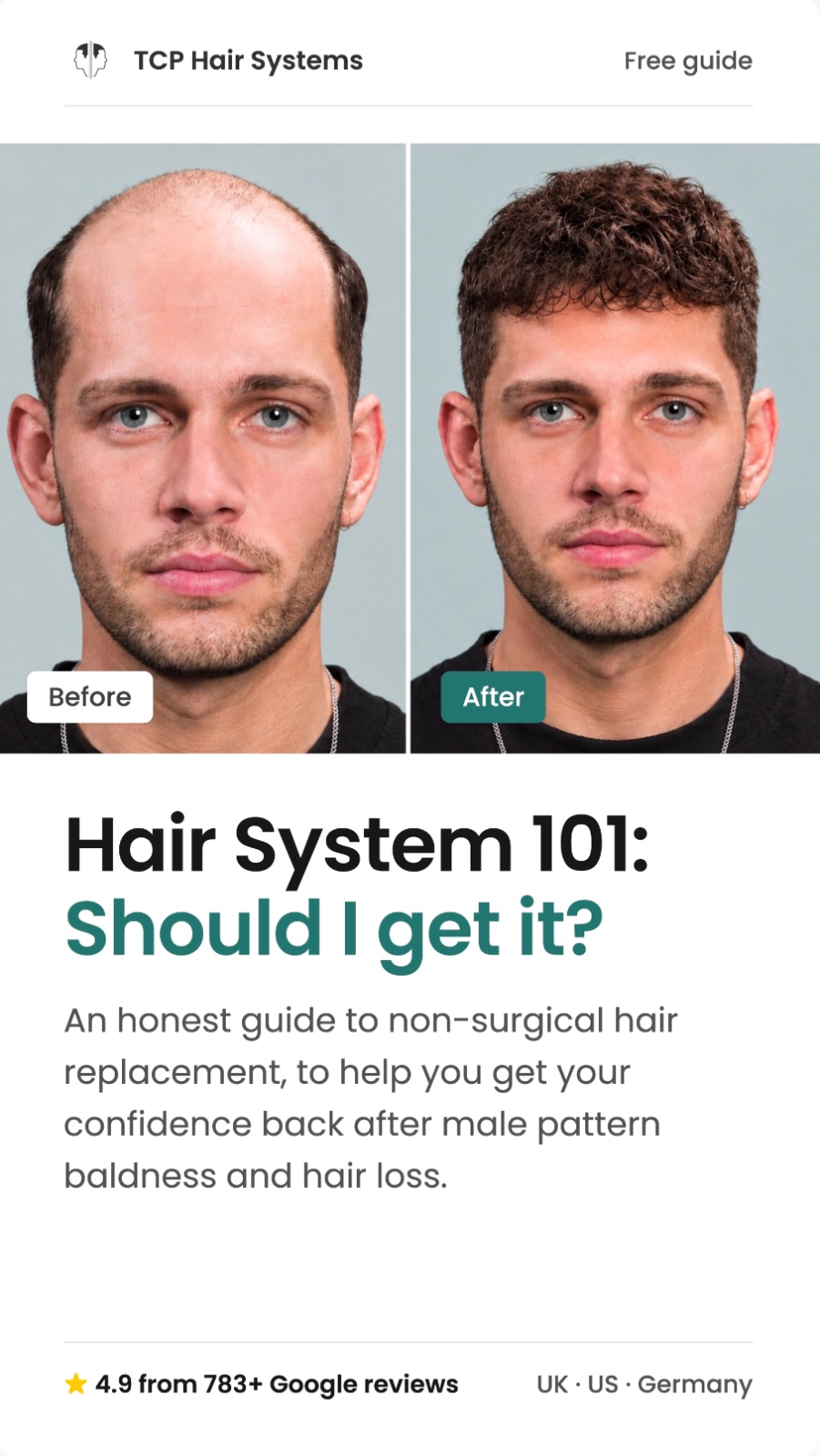
A non-surgical hair system from TCP is a fundamentally different kind of answer. Rather than trying to slow or reverse the biological process, it replaces the hair directly with a custom-fitted system made from 100% real human hair. The result is immediate, no surgical risk, no recovery period, and it works at any stage. Many clients come in after years of trying other approaches and tell us they wish they'd explored a hair system earlier.
Your first consultation is completely free and confidential, no pressure, no commitment. We have studios across the UK, US, and Germany. Book your free consultation today, or see our pricing to find a plan that works.
Every system is also backed by our money-back guarantee. If you're not happy with the result, we make it right, no small print, no exceptions for first-time clients.
Also Read: At What Age Does Male Pattern Baldness Start? | What Are the Signs and Stages of Male Pattern Baldness? | Is There a Cure for Male Pattern Baldness?


We believe so much in our product that we provide a 100% money back guarantee should you not be satisfied with it.
Everything we tell you on our website is real. But we don’t just want you to simply take our word. We know that getting a hair system can seem like a big commitment at first, so we want to make the process as safe and easy as possible. If you, for whatever reason, are not fully satisfied with the standard hair system we will give you your money back.
Here’s how it works:
If you are a first time customer we will refund the full cost of the 1st Standard hair system if you return your standard TCP hair system to the hair studio within 5 business days after the initial application. This applies whether you're on Pay As You Go or Membership, and covers both Standard and Bespoke systems. At the hair studio you will be asked to fill out our return form. Once you have done this, the salon will refund your money in full for the cost of the 1st standard TCP hair system.
What’s not to like?
No.
We know that our TCP AirActive Skin® hair system is the best product on the market and freedom is an essential part of our philosophy.
That’s why we have a solution for everybody – it is up to you if you stay independent with our PAY AS YOU GO option or if you opt for the TCP Membership with its discounted hair system prices. There are no maintenance obligations. The Total Cover Plus hair system should adapt to your life and not vice versa.
Yes. The Total Cover Plus hair system is only removed during your next appointment at the salon, just before you get your new hair system. You can shower in it, exercise in it, do everything as you normally would.
Unlike most other hair replacement methods, which are painful and/or have serious side effects, the Total Cover Plus hair system does NOT hurt at all. We use medical grade, pH neutral materials that have never caused any allergic reactions and do not pose any risk to your health.