
If you've been losing your hair and someone has told you it's “just hair,” you probably already know how unhelpful that is. It's part of how you've always recognised yourself in the mirror. It's tied to how you feel walking into a room, how you think about photos being taken, how you hold yourself in a job interview. This article is about that psychological reach, not the biology of why hair falls out, but an honest look at what hair loss actually does to how people feel and behave.
Hair is one of the most visible aspects of identity, something you actively manage, style, and use to express who you are. When it changes without your choice, the loss isn't just physical. For most people it involves a real recalibration of self-image, and that's genuinely difficult in a way that's hard to articulate to someone who hasn't experienced it.
A systematic review and meta-analysis published in JAMA Dermatology, covering 41 studies and nearly 8,000 patients, found androgenetic alopecia is associated with moderate impairment in both quality of life and emotional wellbeing, concluding that people affected “may need psychological and psychosocial support.” Notably, the impact doesn't correlate neatly with how much hair has actually been lost, someone with early thinning can feel just as affected as someone with advanced loss. What seems to matter more is the gap between how you used to see yourself and how you see yourself now, and that gap can open up even while the visible change is still subtle.
There's also a particular difficulty in how other people respond. Hair loss attracts well-meaning but minimising comments: “plenty of men are bald,” “it doesn't matter,” “you can't even tell.” However kindly intended, these can leave people feeling more isolated, because the message received is often “your distress about this is disproportionate.” It isn't, and the research backs that up.
Hair is also caught up in how we read age and vitality. It's one of the earliest visible signs of ageing, and for those experiencing it in their twenties or thirties, there's often a feeling of being pushed prematurely into a later chapter. The adjustment involved isn't just aesthetic, it's a genuinely significant piece of psychological work.
One of the most striking things about hair loss is how much energy it quietly consumes:
● Choosing seats based on lighting
● Positioning yourself in photos, or avoiding them entirely
● Reaching for a hat before you've quite decided to
● Styling the same way every day because it's the one arrangement that works
These are small things individually, but they accumulate into a low-level vigilance running in the background of daily life, and over time it's genuinely exhausting.
Social withdrawal is one of the most commonly reported consequences, and it tends to compound: as confidence drops, social situations feel higher stakes, which leads to avoiding them, which leads to less connection and further drops in confidence. Many clients describe pulling back from activities involving water, wind, close physical proximity, or unfamiliar lighting, understandable protective responses that still come at a real cost to quality of life.
The impact on work and social functioning is part of what standard quality-of-life research on hair loss actually measures, alongside emotional wellbeing, situations like presentations, meeting new people, or networking events can feel higher-stakes when hair loss has eroded confidence in being seen. That's a concrete cost, not vanity.
Relationships and intimacy are affected too, in ways people rarely discuss openly: anxiety about a partner noticing, feeling less desirable at exactly the moment you most want to feel confident, avoiding physical closeness that might draw attention to thinning areas. These feelings are common and entirely understandable, even when they feel embarrassing to acknowledge.
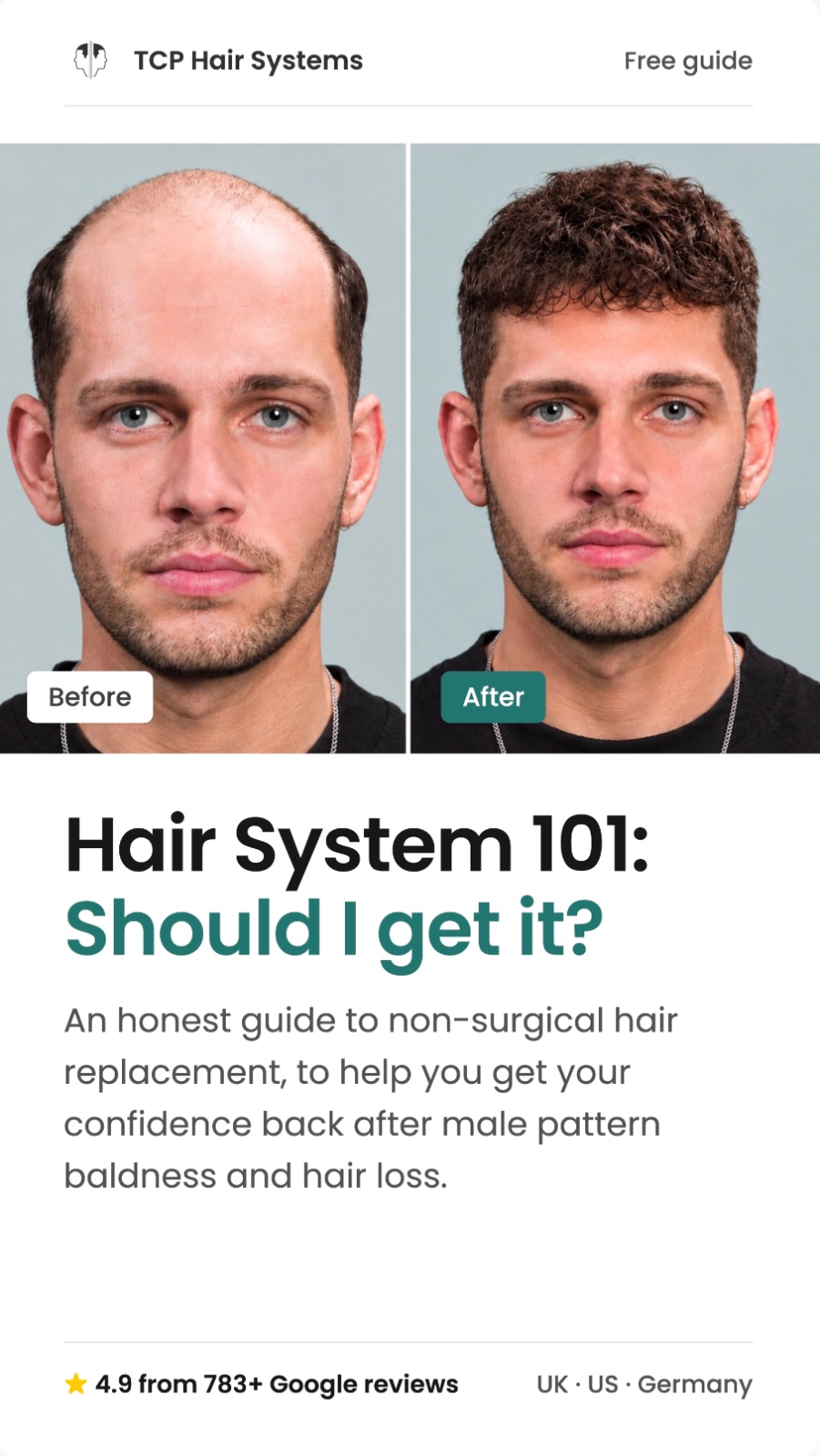
What clients tell us, consistently across thousands of consultations, is that the psychological shift after getting a TCP hair system happens faster than expected. Not just feeling better about appearance, but feeling more like themselves, the version before the vigilance started, before the hat became automatic, before they started calculating where to sit.
That shift shows up in concrete ways: clients who'd stopped going to the gym go back. People who'd been declining invitations start saying yes. Avoided photographs become comfortable again. One client described it as the difference between existing in a room and being present in it, not marketing language, just what people actually say. When the thing consuming background mental energy is resolved, that energy becomes available for everything else.
The confidence that comes from a TCP hair system isn't manufactured. It comes from seeing yourself the way you want to be seen, in a result that's immediate, undetectable, and matched precisely to your own hair. Our before-and-after gallery shows real outcomes from real clients at different stages.
Talking to someone about the emotional impact of hair loss is genuinely useful for some people, and there's no shame in it. A therapist or counsellor can help with the anxiety and identity work involved, and if hair loss has significantly affected your daily functioning or mood, that's worth taking seriously as its own concern. Addressing the emotional impact and addressing the hair loss itself aren't mutually exclusive.
It's worth being realistic about what treatments deliver emotionally, though. Medications like minoxidil and finasteride can slow hair loss for some people, but they don't give you a full head of hair or certainty, so the emotional relief they offer is partial at best. Hair transplant surgery has helped some people significantly, but results aren't guaranteed, recovery is long, and cost is high. Our article on whether there's a cure for male pattern baldness covers this honestly.
A non-surgical hair system works differently because it doesn't try to slow or reverse the process, it replaces the hair directly, applied the same day, with an immediate and complete result. That matters emotionally because it removes the uncertainty. You don't wait months to see if something worked, you see the result the same day, and it's the result you wanted. That certainty is a real part of the psychological value, in a way medication can't replicate.
Your first consultation is completely free and confidential, no pressure, no commitment. We have studios across the UK, US, and Germany. Book your free consultation today, or see our pricing to find a plan that works.
Every system is also backed by our money-back guarantee. If you're not happy with the result, we make it right, no small print, no exceptions for first-time clients.
Also Read: What Are the Signs and Stages of Male Pattern Baldness? | What Causes Hair Loss in Men? | Is There a Cure for Male Pattern Baldness?


We believe so much in our product that we provide a 100% money back guarantee should you not be satisfied with it.
Everything we tell you on our website is real. But we don’t just want you to simply take our word. We know that getting a hair system can seem like a big commitment at first, so we want to make the process as safe and easy as possible. If you, for whatever reason, are not fully satisfied with the standard hair system we will give you your money back.
Here’s how it works:
If you are a first time customer we will refund the full cost of the 1st Standard hair system if you return your standard TCP hair system to the hair studio within 5 business days after the initial application. This applies whether you're on Pay As You Go or Membership, and covers both Standard and Bespoke systems. At the hair studio you will be asked to fill out our return form. Once you have done this, the salon will refund your money in full for the cost of the 1st standard TCP hair system.
What’s not to like?
No.
We know that our TCP AirActive Skin® hair system is the best product on the market and freedom is an essential part of our philosophy.
That’s why we have a solution for everybody – it is up to you if you stay independent with our PAY AS YOU GO option or if you opt for the TCP Membership with its discounted hair system prices. There are no maintenance obligations. The Total Cover Plus hair system should adapt to your life and not vice versa.
Yes. The Total Cover Plus hair system is only removed during your next appointment at the salon, just before you get your new hair system. You can shower in it, exercise in it, do everything as you normally would.
Unlike most other hair replacement methods, which are painful and/or have serious side effects, the Total Cover Plus hair system does NOT hurt at all. We use medical grade, pH neutral materials that have never caused any allergic reactions and do not pose any risk to your health.